I have spent the last several months talking to bank executives about AI. Almost every conversation starts in the same place: internal efficiency. How do we automate compliance? How do we reduce contact center costs? How do we do more with less?
These are fair questions — and the vendors answering them are doing serious work. Compliance review that used to take 45 minutes now takes 15. Transaction monitoring that flagged thousands of false positives now flags hundreds. Contact center QA that sampled 5% of calls now covers 100%. These are real products solving real pain, and banks that invest in them will see real returns.
But there is another conversation starting to happen — quieter, and I think more consequential — about what happens when customers start banking through AI.
MidLyr is early-stage, and we are still learning. But we have spent enough time inside these conversations to notice a pattern worth sharing — and it starts with a question that most of the current AI discussion in banking is not asking.
A distinction worth thinking about
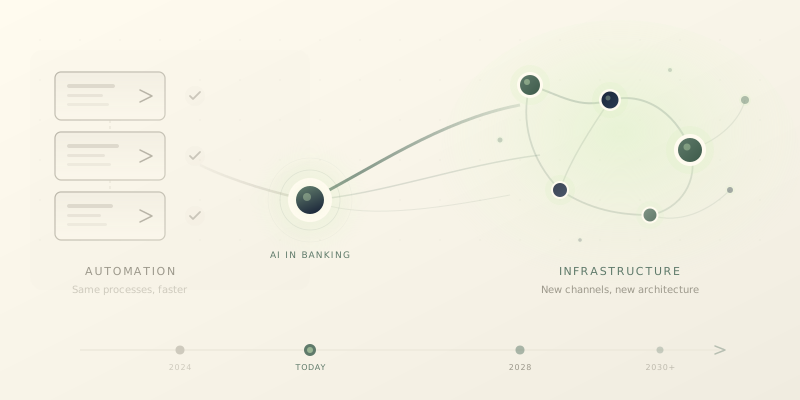
Two different approaches are forming in AI banking right now. They answer different questions and lead to different places.
The first treats AI as automation. The premise is that banking workflows are here to stay and AI makes them faster. The orientation is inward: where are we spending too much, and how do we spend less? The value is measured in cost reduced, time saved, errors avoided.
The second treats AI as infrastructure. The premise is that the banking architecture itself is changing, and AI is the foundation of what comes next. The orientation is outward: where is the customer going, and how do we meet them there? The value is measured in revenue generated, customers reached, channels owned.
The tradeoffs are real.
| Automation | Infrastructure | |
|---|---|---|
| What it does | Makes existing processes faster | Enables processes that were not possible before |
| What changes | Speed and cost | The channel itself |
| ROI timeline | Measurable in quarters — clear, immediate returns | Longer horizon — requires a bet on customer behavior shifting toward AI |
| Risk | Low — improves what already works | Higher — depends on the AI channel maturing |
Automation delivers returns that a CFO can measure in the current fiscal year. Infrastructure is a bet — a bet we believe in, but a bet nonetheless — on a channel that is still forming. Banks that invest in automation are not making a mistake. They are solving present pain with proven tools.
The reason the infrastructure conversation matters is not that it replaces the automation conversation — it is that the infrastructure conversation is barely happening at all. Almost every bank AI discussion we have been part of focuses on internal operations. What happens when customers bank through AI — whether the bank owns that channel or gets disintermediated — is either absent from the agenda or treated as a problem for later.
The pattern in technology transitions is consistent: the “later” problem becomes the “now” problem faster than planning cycles account for.
The question automation does not ask
Take compliance as an example. The automation approach reviews investigation files faster — auto-summarizes case notes, flags high-risk patterns, cuts time per case from 45 minutes to 15. That is genuinely valuable. It delivers ROI immediately, and it addresses a backlog that compliance teams feel every day.
But the investigator still exists. The queue still exists. The process is faster, not different.
Now consider what happens when compliance is designed into the infrastructure of a new channel from the start. Every AI-mediated interaction generates a structured audit trail as a byproduct of how the system works — not as a separate review step. The compliance team’s role shifts from reviewing everything to investigating the exceptions the system surfaces. The queue does not get faster — it gets smaller, because most interactions were compliant by design.
The second scenario does not make the first one unnecessary. Banks need faster compliance now — the backlog is real, the regulatory pressure is real. The point is that both investments deserve to be on the table, and right now, for most banks, only one of them is.
What building for this channel actually requires
If a bank decides the AI channel is worth investing in, the problems to solve are specific and hard. These are not problems automation addresses — they are foundational requirements that need to be in place before a single customer can transact through an AI assistant.
The identity problem. When an AI agent acts on behalf of a customer, how does the bank verify the customer authorized that action? Traditional session-based authentication does not apply when the interface is an AI assistant the bank does not control. We have written about why this requires a fundamentally different authentication architecture — and in our experience, it is the hardest unsolved problem in AI banking.
The multi-channel problem. Customers will not use one AI assistant. They use ChatGPT, Claude, Gemini, and whatever comes next. Infrastructure has to connect to all of them through a standard protocol. Building per-assistant integrations is the equivalent of building a separate mobile app for every phone manufacturer in 2010 — it does not scale, and the ecosystem will not wait.
The compliance architecture problem. In an AI-mediated banking environment, every interaction generates compliance exposure. You cannot sample 5% of AI conversations the way you sample call center calls. The channel needs compliance embedded as a continuous layer — full coverage, automated audit trails, configurable guardrails — rather than review applied after the fact.
The revenue problem. This is the part of the AI channel discussion that gets the least attention. Customers asking AI assistants about their money are often in high-intent moments — “Should I refinance?” “Is there a better savings rate?” — and infrastructure that can surface relevant offers in those moments turns a service interaction into a growth opportunity. The AI channel is not just a cost-deflection play. It is potentially a revenue channel.
These are problems we work on every day at MidLyr, and we have made progress on several of them. But no one has fully solved all of this yet. The infrastructure for AI-native banking is being built in real time, by multiple teams across the industry — and the banks that engage with these problems now will shape how the solutions evolve.
Why the timing question matters
The pattern from previous channel shifts suggests that early movers capture disproportionate value — not because they were smarter, but because they were building while customer habits were still forming.
When banks began investing in mobile infrastructure in 2011 and 2012, the smartphone numbers did not yet justify the investment on a pure ROI basis. But the banks that built early captured the habits — the daily balance check, the in-app transfer, the mobile deposit. By the time others built their mobile apps in 2014 and 2015, those habits had already formed elsewhere, and acquiring them cost significantly more.
AI adoption is following a similar curve, but steeper. ChatGPT’s user base has grown several-fold in the past year alone. Customers are already asking AI assistants about their finances — they are just getting generic answers because their banks are not connected to those conversations yet.
Today, the gap between intent and execution tells the story clearly: the vast majority of financial institutions plan to deploy AI agents, but only a fraction have done so. That gap is not about the models — the technology exists. It is about the infrastructure underneath: authentication, audit trails, action authorization, multi-assistant compatibility. That is the layer that is missing.
This is not an emergency. Banks are not going to lose their customers overnight. But the window for shaping how customers interact with their bank through AI is shorter than most planning cycles assume — and the institutions that start building now will have a meaningful head start over those that treat it as a later conversation.
Three questions that might be worth raising at your next planning meeting:
- When our customers ask AI assistants about their money, does our bank have an answer?
- Are we allocating any resources to the AI channel itself — not just AI for internal operations, but the customer-facing channel?
- If we wait two years to build for this, what habits will our customers have already formed somewhere else?
This is the question we built MidLyr to address — giving banks the infrastructure layer to connect to AI assistants with authentication, compliance, and revenue generation built in. The infrastructure conversation needs to happen alongside the automation conversation — not instead of it, but in addition to it.